
At Taylor Tennis Courts, we’ve been building and resurfacing courts for nearly half a century. While modern tennis courts follow a global standard for size and layout, the court we know today has a fascinating history — full of unique shapes, changing rules, and engineering breakthroughs.
As craftsmen who take pride in honoring the tradition of this sport, we think it’s worth looking back at how tennis court construction evolved over the years — and why the details matter when building one today.
Early Beginnings: Real Tennis
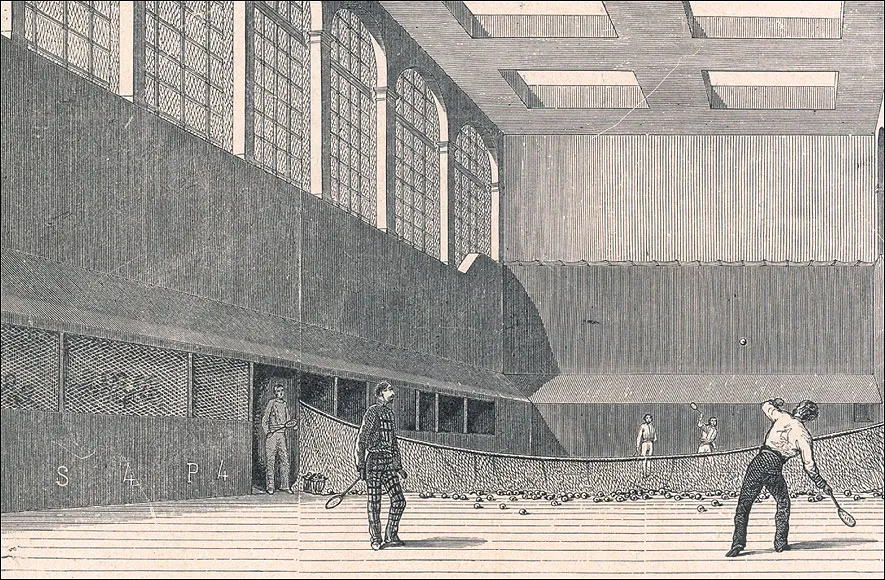
Long before today’s symmetrical courts, tennis looked — and played — very differently. Known as “real tennis,” the original version of the sport was played indoors with complex rules, unusual scoring, and asymmetrical layouts.
These courts were surrounded by four walls, with three of them covered by roofed galleries where spectators could watch. The roofs, called penthouses, were part of the gameplay — players could use them to rebound shots.
The net was also unique: 5 feet high at the posts, dipping to 3 feet in the middle. No two ends of the court were identical.
Today, very few of these historic courts remain. Notable examples include Hampton Court in England, built in 1625 and still in use, and a surviving Paris court from 1908.
1874: Wingfield’s Lawn Tennis Innovation
In 1874, Major Walter C. Wingfield introduced a new version of the game called lawn tennis — the closest ancestor to the tennis we play today.
Wingfield’s original courts were hourglass-shaped, with nets set between 5 and 7 feet high. The game could be played with two or four players, and it quickly spread to the United States.
Though the rules and dimensions changed in later years, Wingfield’s creation marked the first major step toward the standardized courts we know today — earning him the title “Father of Modern Tennis.”
1877: The AEC’s Rectangular Court & the First Wimbledon
The All England Club (AEC) made the next big leap in tennis court construction when it introduced the first rectangular court and hosted the inaugural Wimbledon Championships in 1877.
The rules were almost identical to modern tennis, with just a few differences: service boxes were 26 feet long, and the net stood 5 feet high.
This shift toward symmetry and consistency paved the way for universal rules — and made court construction far easier to standardize.
1882 to Present: Standardizing the Tennis Court
By 1882, tennis had officially adopted the dimensions still used today:
- Length: 78 feet
- Width: 36 feet for doubles, 27 feet for singles
- Alley: 39 feet long
- Service Box: 21 feet long
- Net Height: 3 feet 6 inches at the posts, 3 feet at the center
These measurements ensure consistent play anywhere in the world, allowing players to transition seamlessly between courts.
Building Courts Today: Tradition Meets Modern Craftsmanship
While today’s tennis court dimensions are standardized, quality construction still comes down to experience, materials, and craftsmanship.
At Taylor Tennis Courts, we’ve been perfecting the art of tennis court construction in Southern California since 1979. We know the subtleties of base preparation, surface coating, and line painting that make a court not just playable — but exceptional.
Whether you need a brand-new tennis court, a pickleball conversion, or another type of game court, we bring the same dedication to quality that’s been the hallmark of our work for decades. Reach out for a Quote Here!